Why the Difference Matters for CX Leaders
Author: Juanita Coley, Solid Rock Consulting, CEO
Workforce management is the foundation of every successful contact center. Yet many CX leaders choose the wrong kind of help when trying to fix their operations. Most will meet three types of vendors: technology resellers, system implementers, and operational consulting firms. These options look similar at first. But their role in your organization is fundamentally different — and the wrong choice can be costly.
Choosing wisely determines whether your technology investments improve customer experience, or simply collect dust as another underutilized system.
The Real Goal: Better CX and Operational Performance
What Workforce Management Is Really About
- Inconsistent service levels
- Rising operational costs
- Agent burnout and high attrition
- Poor forecasting accuracy
- Technology that is not delivering value
In many organizations, these challenges are symptoms of deeper operational issues. One of the most common root causes is a lack of discipline in how the workforce and customer demand are managed. Workforce management exists to ensure organizations have the right people, in the right place, at the right time. But WFM is not just a tool or a reporting function — it is a foundational operational discipline that drives CX performance.
How Tech Resellers Approach Workforce Management
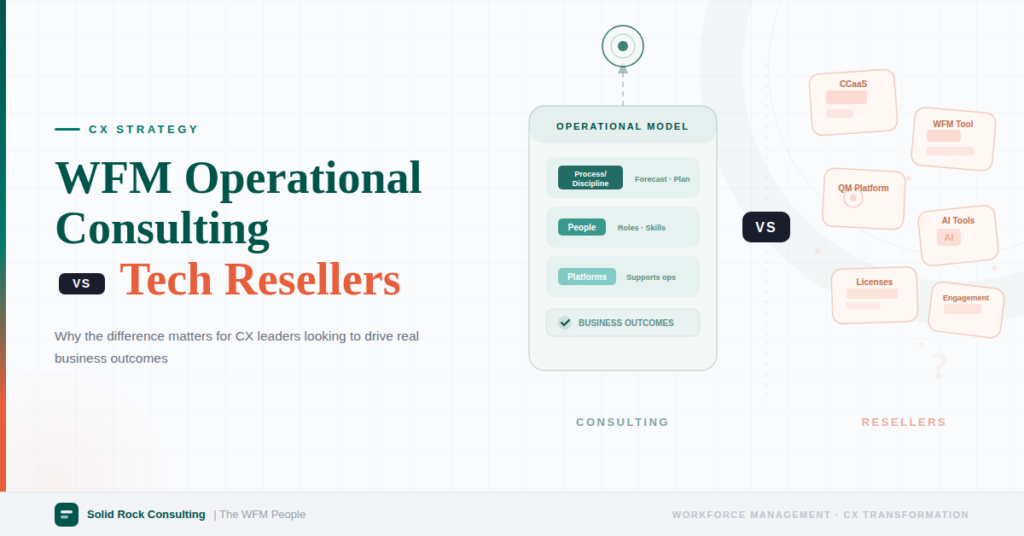
Technology resellers focus primarily on selling and implementing platforms. Their core services typically include selling software licenses, configuring system features, providing technical support, and maintaining system environments. Resellers often specialize in specific platforms such as CCaaS, workforce management systems, quality management tools, and AI solutions.
This work is important. However, it starts with the assumption that technology is the solution. In reality, technology is only one piece of the equation.
How Consulting Firms Approach Workforce Management
An operational consulting firm starts from a completely different place. Rather than leading with technology, it starts with the operating model. This means examining four key areas:
Discipline — How work is forecasted, planned, scheduled, and managed.
Organization & Process — How teams are structured, how decisions are made, and how accountability is established.
People — The skills, roles, and leadership capabilities required to execute the strategy.
Technology — The platforms needed to support the operational model.
As a result, technology becomes the last step — not the first.
How Solid Rock Builds Workforce Management Discipline
Solid Rock Consulting (SRC) helps organizations improve customer experience by strengthening the operational disciplines that drive performance, particularly workforce management. SRC’s approach is built around three layers.
1. Discipline & Process
First, SRC helps organizations establish the operational foundation behind their workforce strategy. This includes forecasting methodology, capacity planning, scheduling strategy, intraday management, and workforce data governance. Without these practices in place, technology rarely produces meaningful results.
2. People & Organizational Structure
Next, SRC focuses on the people and structure required to sustain that discipline. This may involve designing WFM team structures, defining roles and accountability, developing workforce leadership capability, and training internal teams. Many organizations struggle not because they lack software, but because they lack a mature workforce function.
3. Technology & Solution Procurement
Only after the operational model is clearly defined does SRC help organizations evaluate and select technology. Rather than reselling platforms, SRC provides independent guidance to help organizations choose the right solutions across the CX ecosystem — including CCaaS platforms, WFM systems, AI and automation tools, quality management platforms, and employee engagement technology. The goal is to ensure technology supports the operational model, not the other way around.
For organizations already using Verint, SRC also offers professional Verint training services to maximize user adoption across the full WFO suite. https://solidrockco.net/service/professional-services/
Why Skipping Workforce Management Discipline Fails
Many organizations begin their transformation by purchasing new technology. Unfortunately, this often leads to familiar and costly outcomes: systems that are implemented but underutilized, teams that continue operating with old processes, forecasts that remain inaccurate, and leadership that sees limited ROI.
The problem is rarely the software. The problem is that the operational discipline behind the system was never properly designed. In other words, technology cannot compensate for weak processes or unclear accountability.
The SRC Workforce Management Difference
The difference between a reseller and an operational consulting firm is straightforward. Resellers focus on selling technology. SRC focuses on improving the operation that technology is meant to support. That means building the discipline, structure, and strategy required to deliver better customer and employee experiences. Technology becomes part of that journey — but never the starting point.
Strong Workforce Management Drives CX Performance
Ultimately, customer experience outcomes are driven by how well organizations align customer demand, workforce capacity, and operational execution. That alignment requires more than tools. It requires a structured workforce management discipline supported by the right people, processes, and technology.That is why Solid Rock Consulting is known as “The WFM People.” Because behind every great CX operation is a workforce strategy that actually works.
Ready to strengthen your workforce management operation? Contact Solid Rock Consulting to learn how we help CX leaders drive real business outcomes. Click here.